
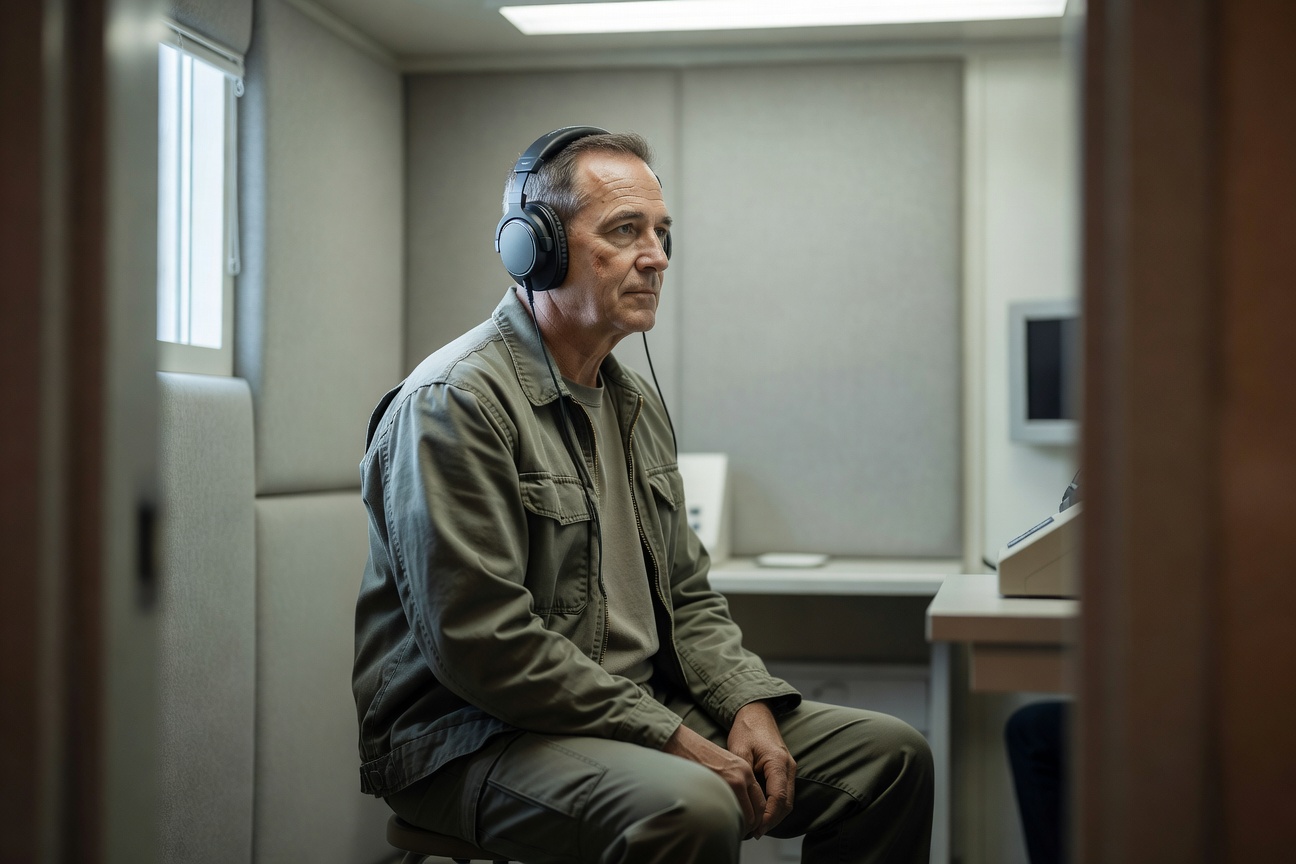
Tinnitus is frequently claimed by veterans because military duties can involve hazardous noise and the symptom is observable by the person experiencing it. Service connection is not automatic. A claim still needs evidence of current recurrent tinnitus, an in-service event or exposure, and a link between them unless a different legal rule applies. DC 6260 provides one 10% schedular evaluation for recurrent tinnitus.

This guide explains the rating rule, the evidence VA may consider, how occupational noise evidence fits, and when a secondary theory requires separate medical evidence.
What it pays in 2026
10% under DC 6260 = $180.42/month, about $2,165.04/year tax-free. Modest on its own — but it adds to other service-connected evaluations under 38 CFR § 4.25. Rates and entitlement can change, so this page does not project lifetime compensation.
The regulation, in one paragraph
38 CFR § 4.87, Diagnostic Code 6260 rates tinnitus at a flat 10%. That is the whole schedule. There is no 0%, no 20%, no 30%. There is no separate rating for bilateral vs unilateral — the Federal Circuit confirmed this cap in Smith v. Nicholson (2007). The note to the diagnostic code instructs that “a separate evaluation for tinnitus may be combined with an evaluation under diagnostic codes 6100, 6200, 6204, or other diagnostic code, except when tinnitus supports an evaluation under one of those diagnostic codes.” In practice: tinnitus is rated alongside hearing loss (DC 6100), not instead of it. They are separate compensable conditions.
A competent report can establish observable symptoms, but VA still evaluates credibility and the complete record. Evidence of noise exposure is not the same as medical evidence connecting the current tinnitus to that exposure, so address each element separately.
Why lay and occupational evidence matter
Three evidence principles are especially relevant:
1. There is no objective test for tinnitus
Audiometry measures hearing loss. Otoscopy looks at the eardrum. Tympanometry measures middle-ear pressure. None of them measures tinnitus. Tinnitus is purely subjective — you hear it, the audiologist cannot directly measure the sound. An examiner may still assess the history, hearing, possible causes, and functional effects.
2. The veteran is “competent” to report it
The cases — Charles v. Principi (Veterans Court, 2002), Jandreau v. Nicholson (Federal Circuit, 2007), and Buchanan v. Nicholson (Federal Circuit, 2006) — discuss that lay testimony about symptoms a layperson can perceive (ringing, pain, fatigue) is competent evidence under 38 CFR § 3.159(a)(2). VA must consider competent lay evidence, but may weigh it with medical, service, and other evidence.
3. An occupational code can help document noise exposure
Military work can involve weapons, aircraft, vehicles, machinery, generators, and other hazardous noise. Adjudication Procedures Manual guidance includes a duty-MOS noise-exposure probability table. An occupational code can help VA develop the exposure question, but it does not itself prove the current diagnosis, nexus, or entitlement.
Examples of occupations that may involve hazardous noise
- Combat arms: 11B, 11C, 11M, 0311, 0341, 0351, 0352
- Artillery: 13B, 13E, 13F, 13R, 0811, 0844
- Armor / cavalry: 19D, 19K, 19A
- Aviation: 15U, 15T, 15W, 67-series, 6112, 6113, 6114, AD/AT/AME-series
- Motor pool / mechanic: 63B, 63A, 91B, 91A, 3521, 3531
- Engineer: 12B, 12N, 1371
- Military police / infantry support: 31B, 5811, 5812
These are illustrative legacy codes, not a current or complete classification list. Verify the code and actual duties in the veteran's service records. An occupational code may support the exposure inquiry, but it does not establish current tinnitus, nexus, or entitlement.
Build the three service-connection elements
Useful evidence may include:
- DD-214 or equivalent service record showing an MOS with noise exposure.
- A personal statement describing the in-service noise exposure (specific events: firing ranges, deployment, generator duty, etc.) and that ringing in the ears began during or shortly after service and has continued.
- A buddy statement (optional) corroborating the noise exposure or that you reported ringing in your ears during service. Submitted on VA Form 21-10210.
What is needed depends on the record. VA may order an audiology examination or medical opinion. A private nexus letter is not automatically required, but the claim still needs adequate evidence connecting current tinnitus to service.
A working lay statement for tinnitus
A strong personal statement is short, specific, and grounded in continuity. Use this pattern:
Lay statement example
Personal statement — combat-arms veteran
I served in the [U.S. Army / Marine Corps / Navy / Air Force / Coast Guard] from [start date] to [end date]. My military occupational specialty was [MOS code and title — e.g., 11B Infantryman].

During my service I was routinely exposed to hazardous noise without consistent hearing protection. Specific exposures I can describe include:
  - Weapons fire on the qualification range (M4, M249, M240B, .50 cal) approximately [frequency, e.g., monthly].
  - [Deployment(s) and combat noise exposure: small arms, IED detonations, indirect fire, helicopter noise].
  - [Generator duty / motor pool exposure / other ongoing noise sources].

I first noticed [ringing / buzzing / another sound] in [approximate date or period]. Since then, it has been [constant / intermittent at an honest frequency]. My post-service work, hobbies, firearm use, head injuries, ear problems, and other noise exposure include: [complete and accurate history].

I certify that this statement is true and correct to the best of my knowledge and belief.

Signed: [Name, date]
Use only facts that are true for you. Cover the actual exposure, honest onset and symptom history, other possible causes, and current effects. Sign and date the statement. The Lay Statement Generator builds this for you with your specific MOS and dates.

The C&P exam: what to expect
The C&P exam for tinnitus is bundled with the hearing-loss exam at a VA Audiology clinic or contracted vendor. The visit is brief — typically 30 to 45 minutes. The examiner will:
- Run a pure-tone audiogram (for DC 6100 hearing loss, separately ratable).
- Run a speech discrimination test (Maryland CNC word list).
- Run otoscopy and tympanometry.
- Ask you about tinnitus directly: do you have it, when did it start, is it constant or intermittent, is it in both ears, does it interfere with sleep, does it affect concentration.
Be ready to describe
- What the sound is like, which ear or ears are affected, and whether it is constant or intermittent.
- When you first noticed it and the accurate timeline of military, occupational, and recreational noise.
- How often it occurs and whether the symptoms changed over time.
- “It interferes with sleep / makes it hard to concentrate / I notice it most in quiet rooms.” (Functional impact — useful for secondary claims even though it does not affect the 10% rating.)
Do not coach or omit facts
Report intermittent symptoms, one-sided symptoms, later onset, and post-service noise exposure if they are true. Be specific instead of minimizing or exaggerating. The examiner needs the full history to give an informed opinion.
For the full C&P pattern across multiple conditions, the C&P Exam Prep tool (Founding Pass) generates personalized checklists by diagnostic code, and the full C&P exam guide covers the universal rules.
Possible secondary theories require separate evidence
Some veterans have other diagnosed conditions they believe tinnitus caused or aggravated. Each theory requires its own evidence under 38 CFR § 3.310. Association alone does not establish secondary service connection.
1. Insomnia / sleep disturbance
Tinnitus may interfere with sleep for some veterans. A clinician must distinguish symptoms from a separately diagnosed disorder and explain causation or aggravation. Obstructive sleep apnea has different causes and rating criteria; tinnitus does not automatically establish that condition. See the sleep apnea guide.
2. Anxiety / depression
Tinnitus can coexist with anxiety or depression. A qualified clinician should determine whether tinnitus caused or aggravated the diagnosed mental-health condition in the individual record.
3. Migraine aggravation
If a clinician concludes that service-connected tinnitus aggravated diagnosed migraines, the opinion should identify the baseline, explain the worsening, and address other causes under § 3.310(b).
A hypothetical combined-rating example
This example shows only how § 4.25 math works if three separate conditions have already been service connected at 50%, 30%, and 10%:
- 50% → 50% efficiency used; 50% remaining
- 30% × 50% = 15% → total 65%
- 10% × 35% = 3.5% → total 68.5% → rounds to 70%
This is math only, not a prediction that any condition will be granted or assigned the example evaluation. Use the What-If Simulator to model your own stack.
The Secondary Conditions Mapper (Founding Pass) presents possible theories as research leads and identifies the evidence questions for each.
Tinnitus vs hearing loss — do not confuse them
Tinnitus (DC 6260) and hearing loss (DC 6100) are separate conditions with different evidence and rating criteria. DC 6100 is evaluated using audiogram results (pure-tone average + speech discrimination) under 38 CFR § 4.85. Having tinnitus does not establish hearing loss, and having hearing loss does not establish tinnitus. Identify only conditions you actually have and submit or identify the relevant evidence for each.
How to file the tinnitus claim today
- If you have not yet filed an Intent to File, do so first — see the back-pay article for why the ITF protects your effective date.
- Open VA Form 21-526EZ. List “tinnitus” and “bilateral hearing loss” (if applicable) as claimed conditions.
- Generate your personal statement using the Lay Statement Generator with your specific MOS, dates, and noise exposure events.
- If a buddy can corroborate, have them complete VA Form 21-10210 with a brief statement. See the buddy statement guide for the 5-element template.
- Submit or identify the relevant evidence. VA will decide whether an examination or medical opinion is needed for the claim.
- When the C&P notice arrives, run the C&P Exam Prep tool (Founding Pass) with DC 6260 and, when hearing loss is also at issue, DC 6100 selected. Use it to organize an accurate history, not to rehearse a desired answer.
- If another diagnosed condition may be caused or aggravated by service-connected tinnitus, review the evidence questions with the Secondary Conditions Mapper (Founding Pass). A listed association is a research lead, not proof of secondary service connection.
The Claim Coach organizes the evidence questions, personal statements, C&P preparation, and a packet a veteran can review with an accredited representative.
Deeper reading
The full tinnitus condition guide carries the complete DC 6260 schedule, medical background, evidence overview, examination topics, and links to related diagnostic codes. For combined-rating math including hearing loss + tinnitus + secondaries, the VA Math Calculator shows the § 4.25 mechanics in detail.

Quick answers
What is the VA rating for tinnitus?
Tinnitus is rated at a flat 10% under 38 CFR § 4.87 Diagnostic Code 6260, regardless of whether it is unilateral or bilateral. There is no 0%, 20%, or 30% tier — the schedule is binary: you either qualify for 10% or 0%. In 2026 dollars, 10% pays $180.42/month tax-free, or about $2,165.04/year.
Do I need a hearing test to prove tinnitus?
Tinnitus is subjective, so a veteran is generally competent to report perceived ringing or similar sounds. VA may still order an audiology examination, review hearing findings, and seek a medical opinion about the cause. Lay evidence can establish observable symptoms, but service connection still depends on the complete evidence.
What is the in-service noise exposure requirement?
You need credible evidence of an in-service event or hazardous-noise exposure. An occupational code, deployment or training records, service treatment records, and specific lay or buddy statements can help. The occupational-noise matrix is evidence-development guidance; an MOS alone does not guarantee that VA will concede exposure or grant the claim.
Can tinnitus be service-connected on a lay statement alone?
A veteran is generally competent to report observable tinnitus symptoms. Charles v. Principi (U.S. Court of Appeals for Veterans Claims, 2002) and Jandreau v. Nicholson (Federal Circuit, 2007) discuss competent lay evidence. But a lay statement does not automatically establish every element; VA may still need evidence of an in-service event and a medical link, depending on the record.
What is the maximum VA rating for tinnitus?
The maximum schedular rating for recurrent tinnitus is one 10% evaluation under DC 6260. Bilateral tinnitus does not receive separate evaluations for each ear. A different diagnosed condition may be considered separately only when its symptoms are not duplicative and the evidence independently supports service connection, including any claimed secondary link.
Can tinnitus cause secondary disabilities?
A veteran may raise a secondary theory for another diagnosed condition when medical evidence shows that service-connected tinnitus caused or aggravated it. Sleep, mental-health, or migraine associations do not create automatic secondary service connection. Each condition requires individualized evidence under 38 CFR § 3.310.
How do I file a tinnitus claim?
File VA Form 21-526EZ listing tinnitus and submit or identify relevant evidence. A personal statement can describe the noise event, symptom onset, frequency, and continuity without exaggeration. Service, medical, and buddy records may also help. VA decides whether an examination or medical opinion is needed.
Built by a veteran. The condition guides are free, forever.
Get the free Secondary Conditions Checklist by email
Educational content only. This is not legal, medical, or financial advice. Always consult an accredited VSO or VA-accredited attorney for claim-specific guidance. CFR citations: 38 CFR §§ 3.159(a)(2), 3.310(a), 3.310(b), 4.25, 4.85 (DC 6100), and 4.87 (DC 6260). Federal Circuit precedent: Charles v. Principi (2002), Jandreau v. Nicholson (2007), Buchanan v. Nicholson (2006), Smith v. Nicholson (2007). Rate values from va.gov/disability/compensation-rates (FY2026, effective Dec 1, 2025). Data validated against current VA.gov and eCFR sources on August 16, 2026.