

An effective-date appeal can feel narrow: you agree with the percentage, but you believe VA started it too late. Then a Higher-Level Review identifies a duty-to-assist error, VA orders another C&P examination, and the new report becomes the basis for a proposed reduction.

That outcome is possible. It does not mean every HLR puts your rating in danger, and it does not allow VA to reduce compensation without due process. Veterans should understand the risk before filing and know exactly what to do if a proposal arrives.
The short answer
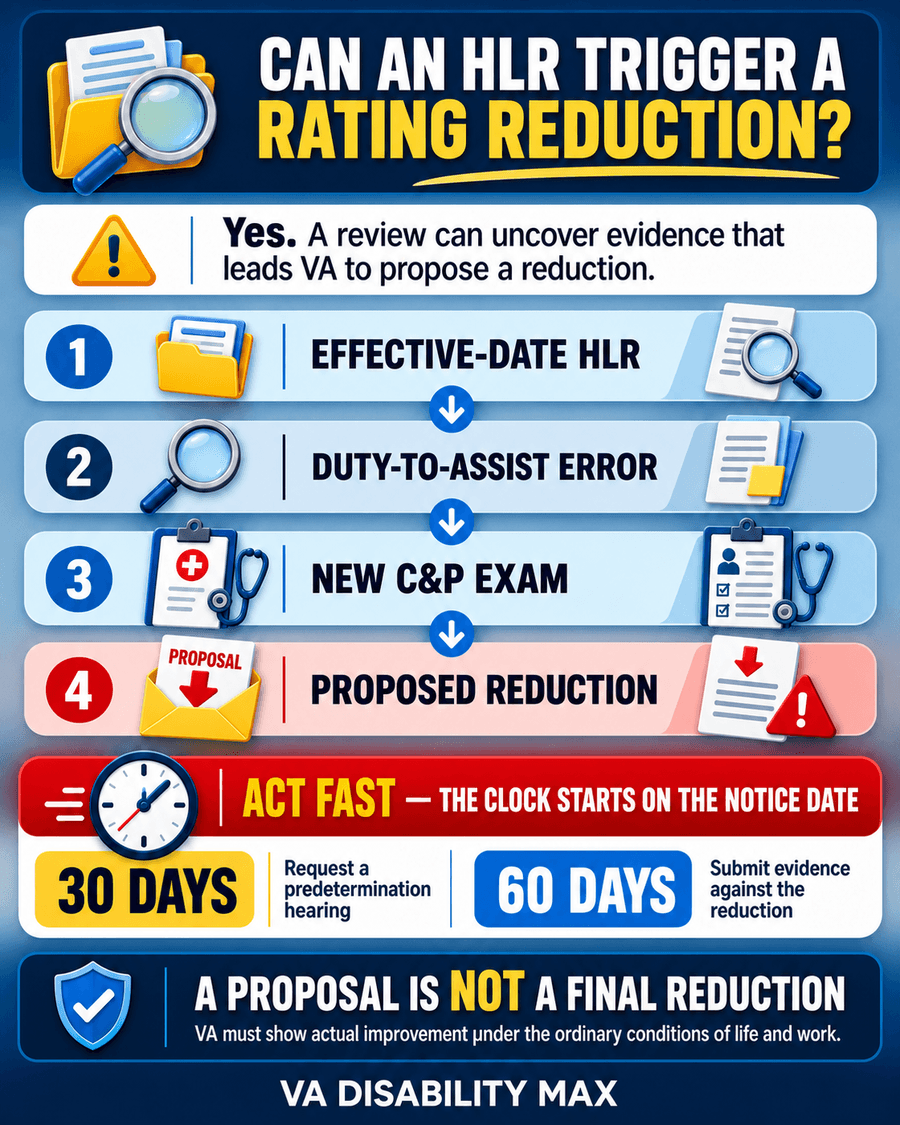
A Higher-Level Review can lead to additional development that produces evidence supporting a proposed reduction. A proposal is not a final reduction. If the proposal would lower current compensation, the veteran generally has 30 days to request a predetermination hearing and 60 days to submit evidence showing why the existing evaluation should continue.
How an effective-date HLR can reach the rating itself
A Higher-Level Review normally examines the existing record for a factual or legal error. You cannot submit new evidence during the HLR. But a senior reviewer may identify a duty-to-assist error, such as an inadequate examination or missing development VA should have completed before deciding the claim.
When VA corrects that error, it may obtain a new examination or medical opinion. That development can affect more than the effective-date question. If a later examination appears to show improvement, VA may begin a separate rating-reduction process.
- The veteran challenges the effective date assigned to an increased evaluation.
- The higher-level reviewer identifies a duty-to-assist error.
- VA orders another C&P examination while correcting the error.
- The new examination reports less severe findings.
- VA issues a proposal to reduce one or more evaluations.
This is why “an HLR uses the same evidence” and “an HLR can eventually lead to new evidence” can both be true. The HLR itself is closed to new evidence. Correcting an identified duty-to-assist error can create a new development stage.
A proposed reduction is not a final reduction
Read the title of the letter carefully. A proposal to reduce is advance notice that VA is considering an adverse action. It is not the final action, and the lower percentage should not take effect immediately.
Under 38 CFR § 3.105(e), when a proposed evaluation reduction would lower compensation currently being paid, VA must explain the material facts and reasons and allow 60 days for additional evidence.
Section 3.105(i) allows the veteran to request a predetermination hearing within 30 days of the notice. When that request is timely, VA continues payments at the existing level while it makes a final determination.
30 days
Request a predetermination hearing.
60 days
Submit evidence against the reduction.
Use the date printed on the proposal notice as the starting point unless the notice provides different instructions. Keep proof of submission.
Do not confuse these two events
An HLR informal conference and a predetermination hearing are not the same thing. The informal conference discusses errors in the decision under review. The predetermination hearing responds to the proposed reduction and carries its own deadline.
What VA must prove before reducing a rating
A reduction case is not simply a new claim for an increase run in reverse. VA bears the burden of supporting the reduction. Veterans Court decisions require VA to review the disability's history and determine:
- Whether the evidence shows an actual change in the disability.
- Whether the examination showing that change was thorough.
- Whether the improvement reflects better functioning under the ordinary conditions of life and work.
That third point matters. A better range-of-motion measurement on one examination day does not automatically establish that the veteran functions better during repeated use, flare-ups, work, household tasks, sleep disruption, or ordinary daily life.
Ratings in effect for five years or longer
Under 38 CFR § 3.344, ratings maintained at the same level for five years or more receive added stabilization protections. VA must review the entire record, compare examinations, and generally avoid relying on a less full or complete examination to reduce a stabilized rating. For conditions subject to temporary or episodic improvement, a single examination may be insufficient.
Ratings in effect for less than five years do not receive every protection in § 3.344(a) and (b). But VA still must establish actual improvement and connect that improvement to ordinary functioning.

Evidence that can answer a proposed reduction
The strongest response is organized around the reason VA gave for the proposal. Useful evidence may include:
- The proposal letter and the examination VA relied on.
- Earlier DBQs or C&P reports supporting the current evaluation.
- Recent treatment records showing continuing symptoms and limitations.
- A medical opinion comparing the earlier and later examinations.
- A personal statement describing flare-ups, repeated-use limitations, and daily functioning.
- A spouse, family member, coworker, or caregiver statement describing observed limitations.
- Work records, accommodations, leave records, or therapy notes showing continuing impairment.
- Evidence that the new examination did not address flare-ups, repeated use, painful motion, or functional loss.
Do not bury the issue under hundreds of unrelated pages. Build a short comparison:
| What VA says improved | What the full record shows | Supporting document |
|---|---|---|
| Range of motion | Results vary during flare-ups and repeated use | DBQ, treatment note, symptom log |
| Pain or weakness | Symptoms continue during ordinary activity | Personal and lay statements |
| Work function | Restrictions and missed work remain | Accommodation or leave records |
| Daily activity | Assistance and limitations remain | Caregiver statement, therapy note |
What to do during the first 72 hours
- Confirm that the letter says “proposed,” not “final.”
- Write down the notice date and both response deadlines.
- Request the predetermination hearing before the 30-day deadline. Follow the delivery instructions in the notice and keep confirmation.
- Get the examination or DBQ that triggered the proposal. Compare it with the examination supporting the current rating.
- Contact a VA-accredited representative. A county or national VSO may assist for free; an accredited claims agent or attorney may also help.
- Build the evidence response around actual daily functioning. Address the proposal's stated reasons directly.
Mistakes to avoid
Waiting for the 60-day deadline before requesting a hearing
The hearing-request period is shorter. Treat 30 days as the first deadline.
Assuming the HLR informal conference already counted as the hearing
It did not. They serve different purposes and occur at different stages.
Arguing only that the condition has existed for years
Service connection and evaluation level are separate questions. Show why the symptoms and functional loss still satisfy the current percentage.
Focusing only on a diagnosis
Most evaluation levels turn on severity and functional impairment, not merely whether the diagnosis remains on a problem list.
Treating “poking the bear” as the legal rule
That phrase describes risk, not law. VA must still follow reduction procedures and support its conclusion with adequate evidence.
Should fear of reduction stop every effective-date appeal?
No. A clear effective-date error can be worth substantial back pay, and many HLRs resolve without any reduction proposal. The better lesson is to make an informed decision:
- Identify the exact error you want reviewed.
- Review whether the current evaluation is well supported.
- Understand that a duty-to-assist finding may lead to more development.
- Ask an accredited representative to review unusually high-stakes cases before filing.
An appeal should be based on the record and the law, not fear and not a promise that nothing else can be reviewed. Review the broader lane comparison in our Higher-Level Review vs. Supplemental Claim vs. Board Appeal guide.

Get the free Secondary Conditions Checklist by email
Quick answers
Can VA reduce my rating during a Higher-Level Review?
An HLR can identify a duty-to-assist error that leads to additional development. If the resulting evidence appears to show improvement, VA may begin a separate proposed-reduction process. A reduction is not automatic and must follow the applicable notice and due-process rules.
Does requesting a predetermination hearing stop the reduction?
A hearing request received within 30 days of the proposal notice keeps benefit payments at the existing level while VA makes a final determination. It does not guarantee that VA will withdraw the proposal.
Can I submit new evidence during an HLR informal conference?
No. An HLR reviews the evidence already in the record. Evidence responding to a later proposed reduction belongs in the reduction-response process described in the proposal notice.
Is one new C&P examination enough to reduce a rating?
It depends on the full record, the adequacy of the examination, the nature of the disability, and how long the rating has been in effect. VA must establish actual improvement in ordinary life and work. Ratings maintained for five years or longer receive additional stabilization protections.
Where can I find an accredited representative?
Use the VA accreditation search or contact a recognized Veterans Service Organization. Verify accreditation before sharing records or signing a fee agreement.
Educational content only. This is not legal or medical advice. Deadlines and procedural rights should be confirmed against the veteran's actual notice. For claim-specific guidance, consult a VA-accredited VSO, claims agent, or attorney. Primary authorities: 38 CFR § 3.105(e), (i); § 3.344; §§ 4.1, 4.2, 4.10, and 4.13. Case law: Brown v. Brown, 5 Vet. App. 413 (1993); Stern v. McDonough, 34 Vet. App. 51 (2021).